Service Areas: British Columbia and Alberta, CA.
Flora and Fauna
Plants and animals also known as Flora and Fauna are what makes earth so special and amazing. No other planet that we know of has life like Earth, plants and animals depend on each other, one can not exist without the other.
Plants and animals form a tightly interwoven system that keeps the planet alive and stable. A few of the most elegant examples:
- Plants produce oxygen, which animals—including us—depend on for survival.
- Animals release carbon dioxide, which plants need for photosynthesis.
- Pollinators like bees, bats, and birds make plant reproduction possible.
- Plants create habitats, from forests to grasslands to coral reefs.
- Animals shape ecosystems, dispersing seeds, cycling nutrients, and maintaining balance.
It’s a mutual dependency that’s been refined over billions of years. No other planet we’ve observed has this kind of dynamic, self-sustaining web of life. Even Mars, with all its scientific intrigue, is silent compared to Earth’s constant hum of biological activity.
What makes Earth special isn’t just that life exists here—it’s that life interacts in endlessly complex ways. Every forest, ocean, and backyard is a living network. Remove one part, and the rest feels it. The laws of nature or immutable; for every action there is an equal reaction.
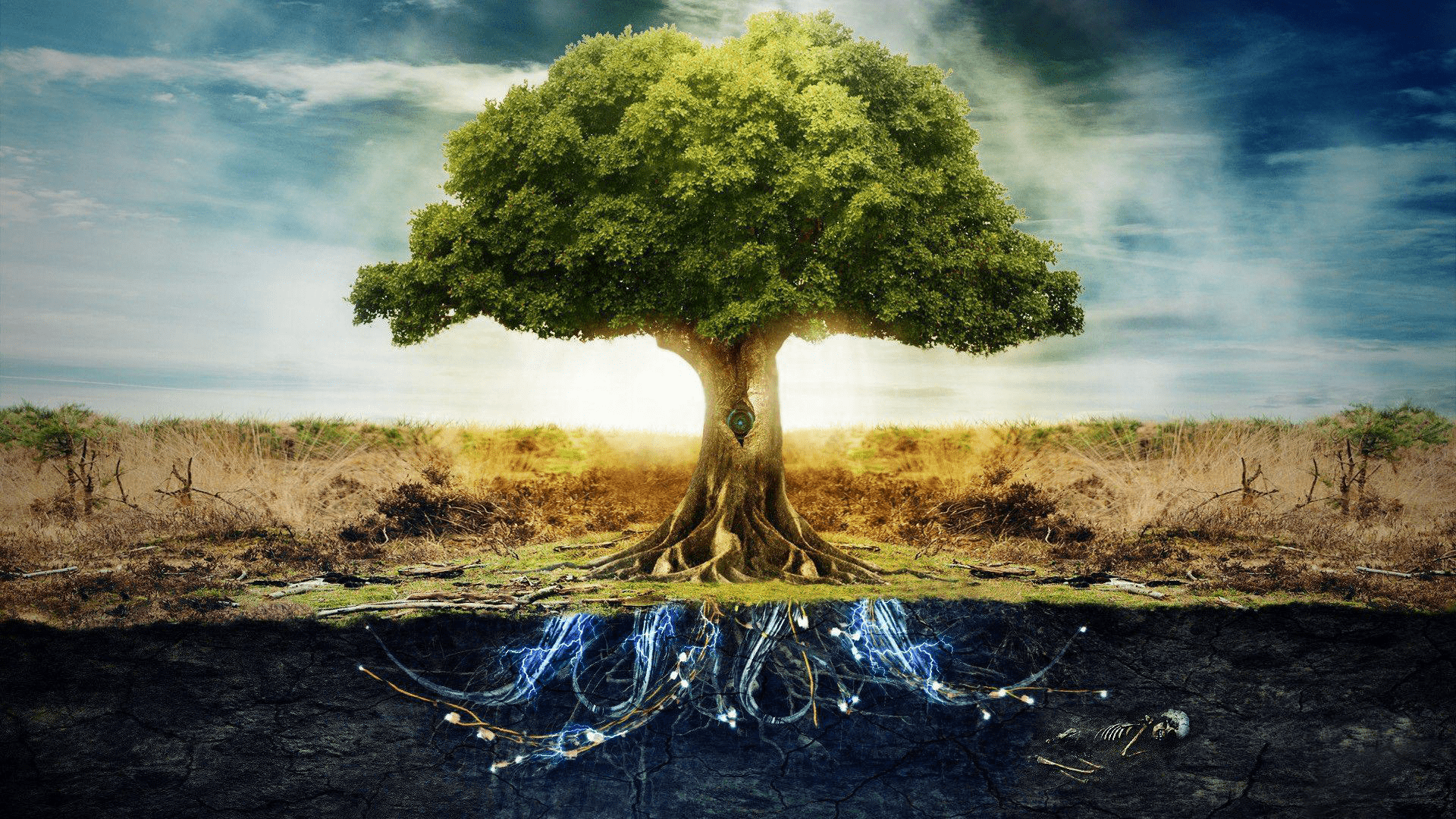
In the beginning, plants and animals existed in perfect harmony, each sustaining the other in a balance so complete that it reflected what God describes as the “Garden of Eden.” It was a world where every living thing fulfilled its purpose without conflict or scarcity, where nothing was wasted and every part of creation supported the whole. This image of Eden endures because it captures the essence of ecological perfection—life interconnected, flourishing, and in equilibrium. Whether understood literally or symbolically, it reminds us that the natural world was designed to thrive through cooperation and balance, and that humanity’s role was once to live within this harmony rather than above it.
Early man’s ignorance and greed:
As the world moved beyond its earliest ages of harmony, the first signs of imbalance began to appear with the rise of early human societies nearly 10,000 years ago. These were the first generations of people who no longer lived solely as wanderers within nature’s rhythms but began to reshape the land to suit their needs. Forests that had stood for thousands of years were cut back to make room for settlements, grazing animals, and early fields. What began as small clearings slowly grew into vast open spaces, breaking apart the continuous forests that once sheltered countless species. With each tree removed, the soil lost a little more of its strength, the rivers shifted their courses, and the delicate web of life that had endured since creation was quietly weakened.
The oceans, too, felt the early weight of human hands. Coastal peoples learned to harvest the sea not just for survival but for surplus, taking fish in quantities the waters had never before been asked to give. Nets grew larger, boats travelled farther, and species that once moved in great, unbroken migrations began to thin. Coral reefs—ancient, living structures—were damaged by early harvesting, anchoring, and the disturbance of once‑undisturbed shores. Though the world was still vast and wild, these first pressures marked the beginning of a slow unravelling, as ecosystems that had existed in perfect balance since the dawn of creation were pushed beyond their natural limits.
These early changes were small compared to what would come later, but they were the first steps in a long journey away from the harmony that once defined the Earth. They set in motion patterns of use, extraction, and expansion that would echo through the centuries, gradually reshaping the world from the Edenic balance of its beginning into something increasingly strained.
Early Human Disruption: From Balance to Barren Lands
As early human societies started clearing of forests and harvesting of coastlines did more than reshape the land and sea—it disrupted the living pyramid that all creatures depend on. When forests were cut back, it wasn’t only the trees that vanished. The animals that relied on them for shelter, food, and migration routes began to disappear as well. Birds lost nesting grounds, grazing animals lost shade and forage, and predators lost the prey that once moved through dense, thriving woodlands. Beneath them, the smallest creatures—worms, insects, fungi, and soil‑building micro‑organisms—declined as the forest floor dried and eroded. These tiny life‑forms, though unseen, were the foundation of the entire pyramid; without them, the soil weakened, plants struggled, and the animals above them suffered in turn.
Over generations, the consequences of this imbalance grew. Regions that had once been rich with forests, grasslands, and flowing rivers began to dry. Without trees to hold moisture, clouds passed over without releasing rain. Winds swept across bare ground, carrying away the last of the fertile soil. What had once been flourishing landscapes slowly transformed into arid plains and, eventually, vast deserts. Much of the Middle East—now known for its harsh, dry climate—was once a mosaic of forests, wetlands, and fertile fields. As vegetation disappeared, so did the animals that depended on it: large herbivores vanished, predators followed, and countless smaller species slipped into extinction as their habitats collapsed. The pyramid of life, once stable and interconnected, fractured layer by layer until entire ecosystems faded from existence.
Early Human Disruption of Climate and Flora and Fauna of the world
As early human societies expanded nearly 10,000 years ago, their clearing of forests and harvesting of coastlines did more than reshape the land and sea—it disrupted the living pyramid that all creatures depend on. When forests were cut back, it wasn’t only the trees that vanished. The animals that relied on them for shelter, food, and migration routes began to disappear as well. Birds lost nesting grounds, grazing animals lost shade and forage, and predators lost the prey that once moved through dense, thriving woodlands. Beneath them, the smallest creatures—worms, insects, fungi, and soil‑building micro‑organisms—declined as the forest floor dried and eroded. These tiny life‑forms formed the base of the food‑chain pyramid, supporting plants, herbivores, and predators above them. Once that foundation weakened, every layer of life felt the strain.
The oceans followed the same pattern. Early over fishing removed not just large fish but the keystone species that kept marine ecosystems stable. With fewer grazing fish, algae spread unchecked, smothering coral reefs. As reefs weakened, countless species lost their nurseries and feeding grounds. Even microscopic plankton—responsible for much of Earth’s oxygen—were affected as currents shifted and coastal waters warmed and clouded. The marine pyramid began to collapse from the bottom up, thinning entire food webs and pushing many species toward extinction.
Over generations, these disruptions reshaped entire regions across Africa and Middle East. Forests that once held moisture, moderated temperatures, and released vast amounts of oxygen were stripped away. With fewer trees absorbing carbon dioxide and producing oxygen, the balance of gases in the atmosphere began to shift. Less vegetation meant less CO₂ being pulled from the air, and more CO₂ lingering to trap heat. At the same time, the loss of forests reduced the oxygen that once enriched the atmosphere. These early changes—subtle at first—marked the beginning of human‑driven climate change, long before the modern world understood the concept. As the land dried, rainfall patterns weakened, clouds passed over without releasing moisture, and winds swept across exposed ground, carrying away the last of the fertile soil.
Vast areas that had once been rich with forests, grasslands, and flowing rivers slowly dried into open savannas and, eventually, expanding deserts. As vegetation disappeared, so did the animals that depended on it, and countless species—large and small—vanished as their habitats collapsed. What had once been flourishing ecosystems across continents became arid plains, barren stretches, and lifeless dust, as the pyramid of life fractured layer by layer until entire worlds of plants and animals faded from existence.
The perfect harmony of life began to falter when humans first cut into the forests and emptied the seas, loosening the threads that held creation together and quietly ushering in the first stirrings of a climate changed by human hands.
The Age of Civilizations: Power, War, and the Thirst for Resources
As agriculture spread and villages grew into cities, humanity crossed another threshold. No longer shaped by the land, people began shaping the land to serve their ambitions. Fields expanded, forests fell, and rivers were redirected to feed growing populations. What had once been small disruptions became sweeping transformations as entire regions were carved into farmland and pasture.
With abundance came hierarchy. With hierarchy came power. And with power came the first organized conflicts.
Nations rose, each seeking control over fertile valleys, forests rich with timber, and mountains hiding metal ores. Wars ignited not from necessity, but from desire — the desire to expand, to dominate, to claim the Earth’s resources as trophies of victory. Armies marched across continents, burning fields, cutting forests, and draining the land of life wherever they passed. Each conquest left deeper scars on the Earth, stripping away the natural balance that had once governed the world via Natural Law.
Governments emerged to command these growing societies, dictating how land would be used, how forests would be harvested, how rivers would be diverted, and how labor would be spent. Decisions made by rulers — kings, emperors, councils — reshaped entire landscapes. Forests became fuel for smelters and shipyards. Mountains were hollowed for metal. Wetlands were drained for farmland. The Earth was no longer a living partner; it had become a resource to be consumed.
Metalworking accelerated this transformation. Bronze, then iron, demanded vast quantities of wood for charcoal. Hillsides were stripped bare to feed furnaces that forged weapons, tools, and machines of war. As empires expanded, so did their appetite for timber, grain, stone, and ore. The land groaned under the weight of human ambition.
Across Africa, Asia, Europe, and beyond, deserts expanded where forests once stood. Rivers shrank where irrigation drained them. Species vanished as habitats collapsed. The atmosphere continued to shift — slowly, steadily — as fewer forests meant less oxygen released and more carbon lingering in the air. These changes, still subtle but relentless, deepened the early currents of human‑driven climate change that had begun thousands of years earlier.
By the time the world approached the modern age, the pattern was set: humanity’s thirst for resources had already changed the face of the planet forever. What remained was only the final acceleration — the last 200 years — when fossil fuels would take this slow transformation and turn it into a rapid, global upheaval of destruction and contamination of the world;s Flora and Fauna.
Farming; in the beginning, one with nature, though as time marched on, modern factory farming has added to the destruction of the natural world.
Before human ambition reshaped the land, the world moved in a quiet, ancient rhythm. Forests breathed in carbon and exhaled oxygen. Grasslands held the soil in place like a woven cloth. Animals wandered freely, fertilizing the ground with every step. Microbes, fungi, insects, plants, and animals formed a single living architecture — a food web so intricate that every creature, from the smallest bacterium to the largest predator, held a thread.
Life was not a hierarchy. It was a conversation.
When humans began clearing forests and burning grasslands, the balance trembled.
- Carbon stored in trees returned to the sky
- Soil lost its protective cover
- Water cycles shifted
- Animals lost habitat
These early disruptions weakened the base of the food web — the plants, the microbes, the insects — the foundation on which everything else depended.
The pyramid of life began to wobble.
For thousands of years, farming remained a partner to nature, not an adversary.
You lived this truth:
- Animals wintered on fields, spreading manure that fed the soil
- In spring they roamed mountains and pastures, living freely
- Their waste fertilized the land in thin, natural layers
- Microbes thrived, plants flourished, insects returned, birds followed
This was farming as an extension of ecology. Animals were not pollutants — they were participants in the nutrient cycle.
The food web remained intact.
Then came the industrial age, and with it, the unraveling of the natural order.
A. Animals Removed From the Land
Chickens were packed into windowless warehouses. Pigs were confined to concrete and steel, unable to turn or root. Cattle were crowded into feedlots with no grass, no shade, no natural world.
Animals stopped fertilizing the land. Their manure became concentrated waste — toxic, anaerobic, dangerous.
The nutrient cycle broke.
B. Soil Torn Apart by Plowing
Industrial plowing ripped open the earth:
- killing fungi and microbes
- releasing stored carbon
- leaving soil bare and vulnerable
- allowing topsoil to blow away or wash into rivers
The living skin of the planet was peeled back.
C. Chemical Dependence
With the soil’s biology destroyed, farms turned to:
- synthetic fertilizers
- pesticides
- herbicides
These chemicals killed insects, weakened plants, and poisoned waterways.
The base of the food web — microbes, insects, plankton, small fish — began to collapse.
No‑till farming emerged as a rediscovery of what the land always knew:
- Soil must remain covered
- Microbes must be protected
- Carbon must stay underground
- Organic matter must accumulate
- Water must be held in place
No‑till farming mirrors the forest floor — a constant blanket of life, never disturbed.
It also mirrors traditional grazing:
- animals moving
- fertilizing
- cycling nutrients
- building soil
This is the path back to balance.
When soil is destroyed, when animals are removed from the land, when chemicals replace biology, the collapse spreads outward like a slow‑moving wave.
A. Soil Life Declines
Microbes die. Fungi disappear. Worms vanish.
Without them, plants weaken.
B. Insects Decline
With fewer plants and more chemicals:
- pollinators disappear
- soil insects vanish
- aquatic insects decline
Without insects, birds starve.
C. Birds Decline
Without insects and seeds:
- songbirds vanish
- raptors lose prey
- migratory species lose their cues
Without birds, predators weaken.
D. Predators Decline
With fewer herbivores and fewer prey species:
- wolves
- foxes
- owls
- big cats
…all lose their place.
E. Oceans Mirror the Collapse
Runoff from industrial farms creates:
- algal blooms
- dead zones
- oxygen‑starved waters
Plankton die. Small fish die. Larger fish starve. Marine mammals decline.
The collapse of the food web is not a single event. It is a chain reaction — a thread pulled from the tapestry until the whole fabric loosens.
Animals are not the problem. Traditional farming is not the problem. Nature is not the problem.
The problem is the industrial systems that:
- removed animals from the land
- tore apart the soil
- concentrated waste
- replaced biology with chemicals
- broke the cycles that sustained life
Climate change is not just a story of carbon. It is a story of broken relationships — between soil and plant, plant and animal, animal and land, land and sky.
And the collapse of food webs is the final symptom of a world where the ancient conversations of nature have been silenced.
The Modern Industrial Era — Atmospheric Change and Global Contamination
As fossil‑fuel use expanded through the 19th and 20th centuries, cities around the world became shrouded in dense industrial smog. Coal and oil combustion released soot, sulfur dioxide, nitrogen oxides, and unburned hydrocarbons that accumulated in the air, forming thick haze that blocked sunlight and reduced visibility. This smog settled into soil, water, and vegetation, weakening forests, damaging crops, and harming wildlife. Many major cities experienced chronic air‑quality crises as the atmosphere filled with pollutants that had never existed in such concentrations before.
The burning of fossil fuels also released acidic gases that altered the chemistry of the atmosphere. Sulfur dioxide and nitrogen oxides rose into the clouds, where they combined with moisture to form sulfuric and nitric acids. These acids fell back to Earth as acid rain, damaging forests, sterilizing lakes, and leaching nutrients from soil. Over time, these pollutants drifted into the upper atmosphere, contributing to changes in the biosphere and even the stratosphere. Some industrial chemicals interfered with ozone chemistry, allowing more ultraviolet radiation to reach the surface and increasing stress on plants, animals, and human health.
Mining and industrial processes added heavy metals and toxic elements to the environment. Coal combustion released mercury, arsenic, lead, and other contaminants that dispersed globally through the atmosphere. These substances settled into rivers, oceans, and ecosystems, entering the food chain and accumulating in fish, birds, mammals, and eventually humans. Over decades, measurable levels of mercury and other metals appeared in virtually every living organism on Earth, from deep‑sea species to high‑mountain wildlife.
The rise of petroleum‑based plastics introduced a new form of pollution. Plastics were durable, lightweight, and easily manufactured, but they did not break down naturally. Instead, they fragmented into microplastics and nanoplastics that spread through oceans, rivers, soil, and air. These particles are now found in marine life, drinking water, agricultural soil, and the bodies of animals and people worldwide. Alongside plastics came synthetic industrial compounds — including PFAS, PCBs, and other “forever chemicals” — that resist degradation and accumulate in living tissues. These chemicals have been detected in wildlife across every continent and in the bloodstreams of nearly all humans tested.
Jet fuel additives, fire retardants, and industrial solvents further contributed to global contamination. Many of these compounds are persistent, bioaccumulative, and toxic, spreading through the atmosphere and depositing far from their points of origin. They have been found in polar ice, deep‑ocean sediments, and remote ecosystems untouched by direct human activity. Their presence in plants, animals, and human populations demonstrates how thoroughly modern industry has permeated the natural world.
Together, these pollutants — smog, acidic gases, heavy metals, plastics, and forever chemicals — altered the atmosphere, damaged ecosystems, and reshaped the biosphere. They changed the chemistry of air, water, and soil, and introduced synthetic substances into every level of the food chain. The combined effects transformed the environment on a global scale, influencing climate, biodiversity, and the health of all living things.